A Nested Rule Set Runs. Manageability Takes Work.
Published on: 2024-08-10 18:36:09
It is 9 a.m. A policy owner asks for one threshold to change before the next release. A reviewer wants to know which applications will be referred, and whether the new exception fits the existing logic.
The decision flow runs, and the work now is to find the right condition, understand its surrounding logic, make the change, and show what the change affects. That can be straightforward. It can also be surprisingly difficult when the policy has grown into a deeply nested structure.
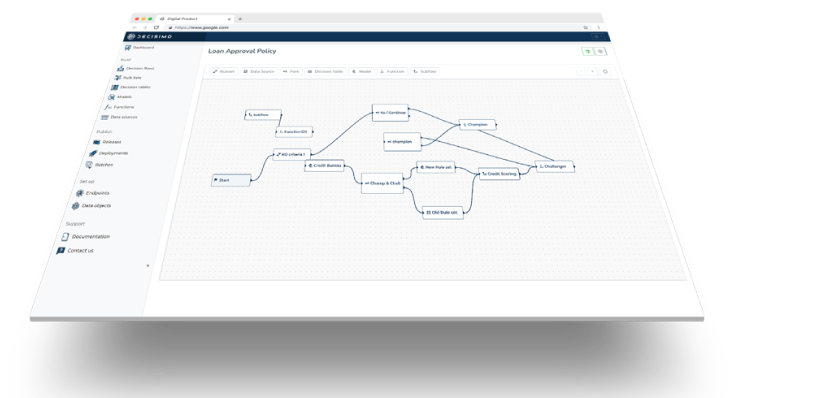
Manageability is a property people can use
A deeply nested rule set is valid input for the platform, and it releases and runs. The pressure appears during change, when a condition sits several levels inside a larger structure alongside other conditions, actions, aggregates, functions, and mappings.
The engine has a shape it can execute, but the people maintaining the policy need a shape they can manage. In lending, a policy may contain knockout criteria, an affordability calculation, a risk score, pricing bands, and referral routing. These parts belong to the same decision flow, yet they answer different questions.
A manageable decision model gives each question a suitable component, and it has a name that tells people what it represents, an owner who can review a change, a test that can run on its own, and a visible difference when the policy changes. It also has a way to tell whether the relevant cases are covered.
Those qualities turn a policy change into a reviewable decision, and they give a risk manager a place to start, a reviewer something specific to inspect, and a test a defined piece of logic to exercise.
A deeply nested condition provides a different experience. Its meaning depends on the conditions around it and on the path through its parent conditions. Its threshold may appear again elsewhere with a different action. The structure can execute while the business meaning remains difficult to locate and review.
Ask what each component is answering
Start with the business question.
A rule set answers a connected set of tests and actions. It can express nested conditions, so it is suitable for independent pass-or-fail tests and for logic that genuinely needs several levels of context. Its flexibility is valuable, but it is also the reason a rule set can become the place where every kind of policy logic accumulates.
A decision table answers a question about alternatives. Its grid puts comparable cases next to one another, and when a row matches first, the executor can stop after that first match rather than continue through the remaining alternatives. This gives the policy a visible ordering of alternatives when ordering matters.
A scorecard answers a contribution question: what does each predictor add to the total? A value falls into a bin, which supplies a score, and the predictor’s weight changes that contribution before the results combine. This is a different meaning from a row that sends an applicant to an outcome.
A decision tree answers a path question: which node follows this one, which conditions and actions belong on the route, and what happens on the default path? The links and default setting make those choices part of the model’s visible structure.
Consider two lines in a policy document:
Age 25 to 34: 20 points
Age 25 to 34: refer
The input condition is identical, but the policy meaning is different. The first line contributes to a number; the second line selects an action. If both lines disappear into a general collection of nested conditions, the distinction becomes harder to review. The score belongs in a scorecard. The referral belongs in a decision table, rule set, or decision tree according to the surrounding policy structure.
A scorecard adds: each predictor produces a score from the bin containing the value, that score is multiplied by the predictor’s weight, and the resulting contributions combine into a total. A decision table treats rows as alternatives, taking the first matching row when configured to stop on the first hit. One asks how applicable factors add together; the other asks which applicable case gets used.
Use a scorecard when the policy builds a total from weighted predictors. Use a decision table when the policy selects among alternative rows. A rule set remains suitable when the policy contains independent tests or connected logic that does not fit those shapes.
Check what the structure can show
Both execute.
A decision table can be checked for overlaps and gaps because its rows and columns provide a grid for comparing cases pairwise. Reviewers can examine whether alternatives overlap and whether parts of the intended range remain uncovered.
A nested rule set has a different structure. Parent conditions connect the logic across levels, rather than placing comparable cases into a grid. The platform has validation for decision-table overlaps and gaps; it has no equivalent overlap or completeness validation for rule sets.
The boundary matters. A rule set can express a deeply nested policy and run it. A decision table can express alternatives in a form that supports overlap and gap checks. Only one can be checked.
Choose the table when the business question is whether a set of alternatives covers a space cleanly. Choose the rule set when the business question requires connected or nested tests. The choice affects what reviewers can inspect after the policy is built.
Name each policy question
A threshold without a name has no clear owner. The same term can then mean a score contribution in one branch, a referral trigger in another, and an eligibility test somewhere else.
When a policy uses a threshold, give it a component that reflects its role. A band that contributes to a number belongs with the scorecard. A repeated combination of attributes that selects an alternative belongs in a table. Pass-or-fail tests use rule sets.
This separation gives the policy language a place to live. Reviewers can ask who owns the score contribution, which rows cover the alternatives, or which test controls the referral. The model carries those distinctions instead of leaving them in surrounding documentation.
Refactor the nest you already have
Start with repeated combinations. If the policy keeps checking the same fields in different branches, place those alternatives into a decision table where the cases can be viewed together.
Next, find contributions. Move the predictors, bins, scores, and weights into a scorecard so the total has a visible structure.
Keep independent pass-or-fail tests in a rule set. A rule set suits conditions and actions when they need connected or nested logic. A decision tree can provide the clearer shape when the important question is the path from one node to the next, including its default route.
Finally, separate arithmetic from branching. Put the calculation in a function, then put the guard or decision around that calculation in a rule set. A function computes; the paired rule set handles the branch.
These changes do not begin with a demand to rewrite the whole policy; instead, they begin with meaning: find the part that adds, the part that selects, the part that follows a path, and the part that tests eligibility. Give each one a component that makes its work visible.
The model then says what each part does. That is the practical meaning of a manageable decision flow.