What data analytics areas need to be covered in the lending business - Decisimo
Published on: 2024-08-10 18:37:05
To make data-driven decisions in lending, companies need to apply a range of data analytics methods. The insights from that work should support better decision-making.
In fast-moving businesses such as BNPL and point-of-sale consumer lending, decision-making happens across many areas. Many of those decisions can be automated, and decision models do not need to be run by humans. They can be run by a decision engine.
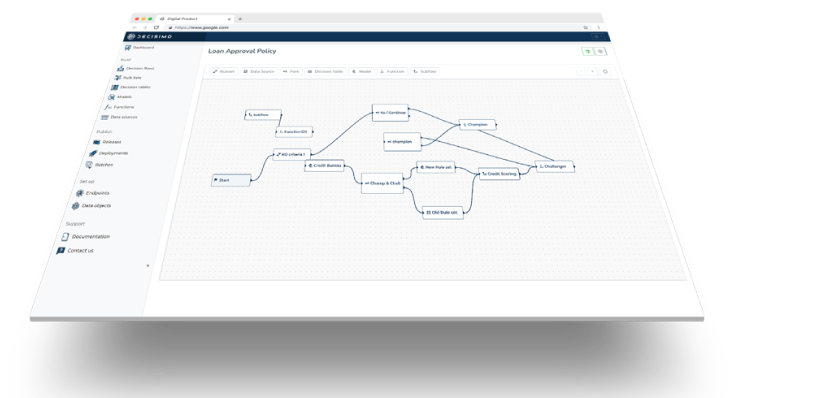
The areas a lending business should cover with data collection and analytics include, but are not limited to:
- Marketing: Identifying and segmenting the customer base
- Sales: Predicting customer behavior
- Risk management: Using data to identify and assess risk
- Credit policy: Assessing creditworthiness
- Antifraud: Detecting fraud
- Portfolio management: Forecasting loan performance. Predicting default rates and loss given default.
- Product: Optimizing pricing and marketing strategies. Determining optimal interest rates.
- Process management: Identifying opportunities to improve processes. Reducing processing time
- Market Insights: Benchmarking against industry peers
- Customer services: Analyzing customer satisfaction levels.
- Employee performance: Analyzing employee productivity and motivation.
Each of these areas needs different data sets and analytical methods, but all of them matter for informed decisions in lending.
Marketing
Data analytics helps identify and segment customers, and evaluate marketing channels. These are among the main tasks of a marketing analytics team.
Marketing tasks often focus on which channels bring in the best customers, not just by cost per lead, but also by approval rate and risk performance for each channel.
The goal of marketing analytics is to assess customer profitability and find ways to increase the number of high-quality leads and loan applications.
Sales
In sales, data analytics helps teams understand what customers want and need.
This helps sales teams close more deals by offering products and services when they fit customer needs. Data analytics also helps teams understand customer behavior, so they can define and prepare suitable products and partnerships.
In business models that use sales agents, analytics on each agent's sales performance and the performance of booked loans can help identify the strongest agents.
It can also help design the right incentive package for each agent.
Risk management
Risk management is one of the main areas for data analytics in lending. Data analytics helps identify and assess risk in the portfolio. It also helps develop and stress test risk models.
In risk management, data analytics is used to better identify, quantify, and manage risk.
This includes understanding which products and customers carry the most risk, setting exposure limits, and monitoring risk over time.
Data analytics can also be used to monitor and report on risk continuously. That matters for keeping the portfolio healthy and avoiding losses.
Credit policy
Part of risk management is defining the credit policy for underwriting loans. Data analytics supports this by helping assess borrowers.
This includes understanding the borrower's financial situation, ability to repay, and credit history. Data analytics can also identify trends in creditworthiness. Those trends may be tied to the economic cycle or local economic conditions.
It is important to assess not just the borrower, but the wider situation as well. That helps set the right interest rates and loan terms. It also helps identify which borrowers are more likely to default.
Antifraud
In lending, data analytics also helps detect fraud. It does this by looking for anomalies in the data that may point to fraud.
This includes signals such as multiple applications from the same IP address or fake identities. Detection often depends on spotting anomalies and sudden spikes in concentrations around a pivoting fact. Data analytics can also identify fraud patterns so new cases can be prevented.
Outcomes from antifraud analytics usually lead to changes in underwriting processes and changes to credit policy decision models.
Because these changes can happen often and need a fast response, it helps to have decision logic that is easy to update. The longer it takes to put new rules into policy, the greater the financial loss fraud can cause.
Portfolio management
Data analytics also plays a role in portfolio management. It helps predict loan performance. It also helps identify which loans are at risk of default and which loans are likely to perform well.
This helps portfolio managers decide which loans to keep on the books and which to sell. Data analytics also helps forecast loss given default. That matters for setting provisions and managing overall portfolio risk.
Product
Data analytics is also used in product management. It helps optimize pricing and marketing strategies. It also helps determine the right interest rate for products.
This matters for pricing products correctly and making sure they are marketed to the right audience. Data analytics can also show which products are most profitable and which are most exposed to default risk.
Using these metrics, product profitability is calculated by considering these costs:
- acquisition costs
- servicing costs,
- funding costs (interest expense)
- costs of loss given default
- collections costs
Against income streams:
- interest income
- income from additional services (fees, insurance)
- late payment fees
- potential future income from cross-sell and upselling activities.
- sales comission fees from merchants
Process management
Data analytics can also improve processes. It does this by identifying opportunities to improve processes. It can also reduce processing time.
This matters because loans processed quickly and efficiently tend to attract better customers, who can choose their lender. More strong customers lead to a healthier portfolio overall.
Market Insights
Data analytics can also provide market insights. This is done by benchmarking against industry peers. It can also help identify trends in the industry.
This matters for keeping up with market changes and making sure the lending business is positioned correctly. It also helps ensure that products and services match customer needs.
Customer care
Data analytics can also improve customer care. It does this by identifying customer needs and the best time to contact customers. It can also identify upsell and cross-sell opportunities.
This matters for keeping customers satisfied and making sure the lending business maximizes revenue from each customer. It also helps the customer care team work efficiently.
Analytics in customer care can also reduce the risk of unhappy customers moving to competitors for refinancing. A refinanced loan can reduce future income. If that happens across a large part of the portfolio, it can seriously damage overall profitability.
Employee performance
Data analytics can also improve employee performance, especially in sales. It does this by identifying which employees are the most productive and which need additional training. It can also identify which employees may be at risk of turnover.
This matters for keeping the lending business efficient and making sure employees stay engaged and motivated. It also helps the business attract and retain strong employees.
Conclusion
In today's lending market, data analytics is used more widely across the business. That is because it can improve decision-making, optimize pricing and marketing strategies, and improve customer care.
It can also reduce processing time, detect fraud, improve portfolio management, and provide market insights. Taken together, these uses show that data analytics is now a core part of lending.