How life insurance underwriting turns an application into terms
Published on: 2026-08-31 16:27:50
What an underwriter is actually deciding
The underwriting question is usually not simply whether an application can be accepted. It is what terms should apply to the life described by the evidence.
The possible answer is broader than many people outside underwriting expect. An application can receive standard rates. It can receive rated terms at a loading. A named cause can be excluded from cover. The decision can be postponed until a later date, or the application can be declined.
Those outcomes describe different responses to uncertainty and risk. A postponement means that something remains open and should be reviewed later. An exclusion changes what is covered. A loading changes the price after the risk has been assessed. Numerical rating is the method used to express part of that assessment.
The unit: what a debit is
Numerical rating prices a life that is not standard against a standard mortality table. A debit represents one per cent of extra mortality. A total of 75 debits therefore means that the life is expected to die at 175 per cent of the standard rate for its class.
That identity is a mortality rating. It is not a 75 per cent premium increase, and it does not mean that the customer pays 75 per cent more. Turning the mortality rating into a premium is a separate pricing operation.
The premium cannot be increased in direct proportion to the debit total because the expense loading in a gross premium does not scale with mortality. The extra mortality is also measured against actual mortality rather than tabular mortality. That is why rates under substandard table D are not double the standard rates, and table B rates are not one and a half times them.
The method was published by Oscar Rogers and Arthur Hunter of New York Life in 1919. Its shape has not changed. A schedule produces the mortality rating, then a separate pricing step turns that rating into terms.
What a schedule looks like
A schedule breaks underwriting factors into bands. Each band carries a debit value, and the selected values are summed. The bands within a factor should cover the possible values exactly, so a value falls into one band rather than two or none.
An unanswered application question is part of that design. Each factor opens with a band for missing information, and that band carries no debits. It is an explicit result for the information received, rather than an accidental gap in the schedule.
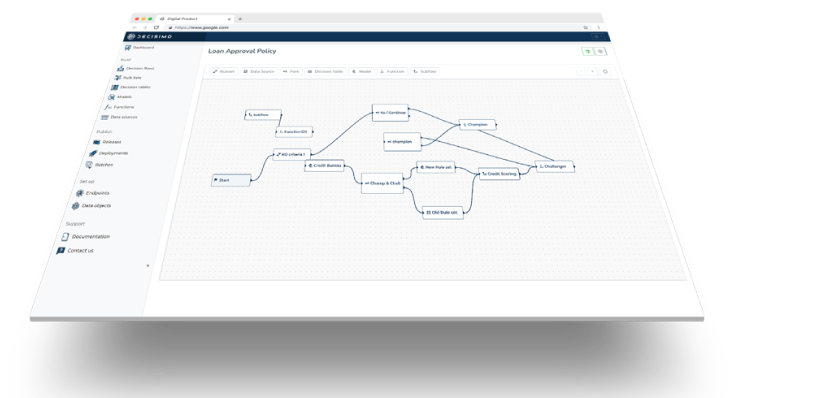
The illustration uses five factors and shows how their bands contribute to a total. It is a scorecard in Decisimo: named predictors are banded and summed. The particular schedule is only an illustration. It is not an insurer’s own schedule, and its numbers are not a recommendation.
For the exact bands and debit values in the illustration, see the life insurance schedule example.
{{schedule_table}}| Factor | Band | Debits |
|---|---|---|
| Build | not disclosed | 0 |
| under 18.5 | 25 | |
| 18.5 to under 32 | 0 | |
| 32 to under 35 | 25 | |
| 35 to under 38 | 75 | |
| 38 to under 42 | 150 | |
| 42 and over | 250 | |
| Blood pressure | not disclosed | 0 |
| under 140 | 0 | |
| 140 to under 160 | 25 | |
| 160 to under 180 | 75 | |
| 180 and over | 150 | |
| Alcohol units a week | not disclosed | 0 |
| under 21 | 0 | |
| 21 to under 36 | 25 | |
| 36 to under 51 | 75 | |
| 51 and over | 150 | |
| Disclosed condition | not disclosed | 0 |
| none | 0 | |
| managed | 25 | |
| complicated | 150 | |
| severe | 300 | |
| Hazardous pursuit | not disclosed | 0 |
| none | 0 | |
| diving | 25 | |
| motorsport | 75 | |
| mountaineering | 100 |
From a total to an answer
The debit total is not the final underwriting answer. A second set of bands maps the total to an outcome, and those bands must cover the whole range with no gap or overlap. Every life should therefore land in exactly one result.
The result can be standard, a stated increase in extra mortality, or decline. The percentages in that mapping continue to describe extra mortality. They are not percentages of the premium.
An open investigation is handled separately. It produces postponement and a later review rather than forcing the file into a rating or decline. The exact terms mapping appears below.
This kind of application is case work when the file stays open over days and a late medical report causes conclusions that depended on older evidence to be run again. The case work explanation describes that kind of open file.
{{terms_table}}| Total debits | Investigation open | Outcome |
|---|---|---|
| 0 to under 50 | no | Standard rates |
| 50 to under 100 | no | Rated at plus 50 per cent extra mortality |
| 100 to under 175 | no | Rated at plus 100 per cent extra mortality |
| 175 to under 250 | no | Rated at plus 200 per cent extra mortality |
| 250 and over | no | Declined |
| any total | yes | Postponed, reviewed in 3 months |
What is deliberately not in the schedule
Age is not a debit. The standard mortality table is built around age, so the debit schedule expresses extra mortality on top of the basis that already applies.
Sex is different for EU business. It is not a rating factor in the table or in the debits. In Test-Achats, case C-236/09, the Court of Justice of the European Union ruled that using sex as a rating factor in insurance was incompatible with EU law. EU insurers have therefore been required to use unisex premiums since 21 December 2012.
Smoker status also does not work like a debit. It selects the rate basis that applies. A smoker can be standard on smoker rates, because standard describes the selected basis rather than a comparison with non-smoker rates.
These distinctions prevent the schedule from becoming a container for every underwriting variable. Some information selects the underlying basis. Some information contributes extra mortality. Some circumstances lead to an exclusion or postponement instead of a price adjustment.
Why the method survives the regulation
A rating built from named debits can be taken apart again. The record can show each factor, the band selected for it, and what that band contributed to the total. That makes the route from application evidence to mortality rating inspectable.
Article 22 of the GDPR already gives a person subject to a solely automated decision the right to human intervention and a meaningful explanation. A scorecard can make each predictor contribution available in the explanation, but a process still needs the appropriate human involvement.
Annex III of the EU AI Act names risk assessment and pricing in life and health insurance as a high-risk use. The obligations apply from 2 December 2027, following the extension from 2 August 2026 by the AI Omnibus. They include logging, technical documentation, and meaningful human oversight. An automated underwriting rules engine must therefore sit within a process where a person can review and approve the decision.
In Decisimo, the scorecard and decision table are built and changed in an editor. Each entity carries revision history, and a change reaches production through an approval sequence that a person signs off. Execution has zero data retention, and execution traces live on the customer side. The governance overview covers the surrounding controls in more detail.