Using Champion x Challenger in decision strategies
Published on: 2024-08-10 18:36:47
When you start using a new decision model for an existing decision strategy, the goal is to verify whether the new model or strategy performs better than the previous one.
A sound practice is to use a Champion x Challenger validation approach. The goal is to compare the performance of the Champion, which is the current decision model, against the Challenger, which is the new decision model.
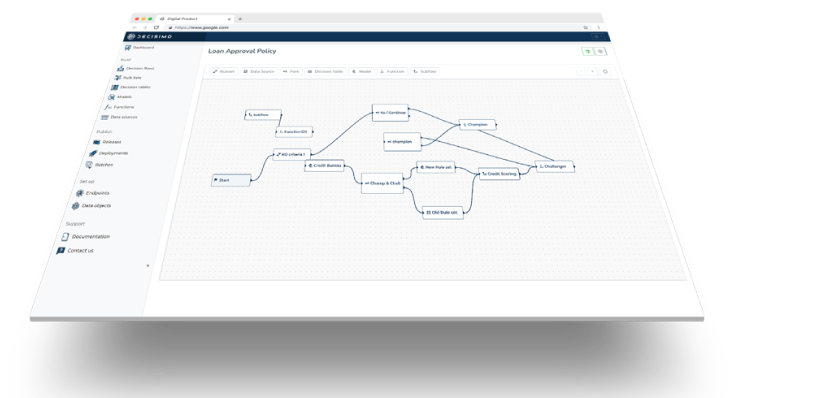
This approach is especially useful when the new decision model is not fully developed yet, and there is still uncertainty about its performance.
In high-impact decision strategies such as credit underwriting, Champion x Challenger should be standard practice. Testing and gradual rollout help keep portfolio performance stable.
Using a Champion x Challenger validation approach gives quick feedback on how the new model performs, and helps identify where it needs improvement.
How it can be done?
Here is a simple example of how the Champion x Challenger validation approach can be used.
Suppose we have a decision model that determines which offers to present to customers. The model has been in use for some time, and we now want to develop a new decision model that uses a different approach to offer selection.
As we develop the new decision model, we keep the historic baseline model as the Champion, which continues to evaluate most cases. The new decision model acts as the Challenger and is used to evaluate a holdout.
By holdout, we mean a sample, usually random, that is evaluated by the Challenger.
If we find that the new model outperforms the existing one, we can replace the existing model with the new one. The replacement can be gradual or done in one step. If the new model does not outperform the existing one, we can improve it further or continue using the existing model.
Advantage of Champion x Challenger
The main advantage of the Champion x Challenger validation approach is that it lets us compare the performance of the new model against the existing model or baseline without waiting for the new model to be fully developed.
Another advantage is that it shows the real-world impact of using the model for decision-making, because in-vitro simulations are often very different from live decisions.
Practical implementation in a decision engine
Most Champion x Challenger implementations use one random number or several random numbers. The random number is part of the data object inside the message used to execute a decision flow.
When only one part of the decision flow is being challenged, one random number may be enough.
When there are multiple challenger areas in the decision flow, multiple random numbers should be used. Each challenger area gets its own random number and runs with that number. This prevents possible cross-correlations.
At the end of execution, all decision results are stored together with the random number that was used.
Any model within a decision flow can be used for Challenger x Champion. This can be a new decision table segmentation, a single decision table row, one rule, or a whole rule set. You can also challenge the performance of different third-party data sources against each other.
When to especially use Champion x Challenger?
Champion x Challenger is especially useful when the outcome of decisions takes longer to unfold.
For example, in consumer lending, credit risk performance and default vintage shape can take half a year to show fully. In that case, switching blindly to a new model would make it hard to see whether vintage performance changed because of the model or because of external conditions.
By keeping Champion and Challenger vintages side by side, performance evaluation becomes easier. If sample sizes are statistically significant, there is less doubt about other factors.
Another example is a marketing campaign, where outcomes such as customer lifetime value can take longer to develop. In those cases, the decision may be designed well, but outlier performance and the propensity to take up additional services may still be unclear.
Conclusion
Champion x Challenger is a sound validation practice when developing and using new decision models. It allows us to compare the performance of the new model against the existing model or baseline quickly.
When using Champion x Challenger, we need to make sure sample sizes are large enough for statistical significance, and we need to account for possible selection bias.
Where possible, Champion x Challenger should be used in cases where decision outcomes take longer to unfold.