Who, or What, Makes the Decisions Here?
Published on: 2024-08-10 18:48:28
Every company runs on decisions. Approve a loan, flag a transaction, adjust a limit, route a claim. The question is not whether decisions happen, but how they are made and who controls the logic.
In many organizations, these decisions still rely on manual processes or scattered business rules across systems. That slows operations and creates risk. Policies drift, rules are applied inconsistently, and changes take time to deploy.
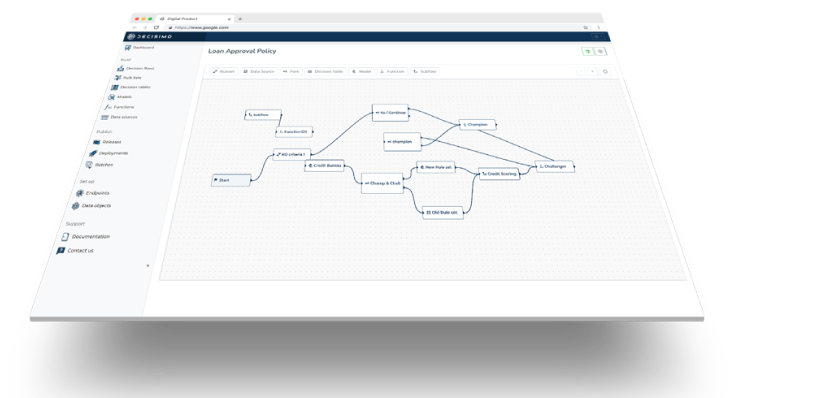
Decision engines solve this by centralizing decision logic. Rules become explicit, auditable, and consistent across every transaction.

Here are several reasons companies adopt decision engines:
- Structured decision logic: Take a credit application. A rules engine evaluates every rule in the same order, every time. It does not skip policies, miss thresholds, or apply exceptions based on subjective judgment.
- Faster transaction processing: Customers expect immediate answers. A manual workflow handles one request at a time. A decision engine evaluates thousands of transactions in parallel.
- Lower operational error rate: Human workflows create variation. A decision engine executes defined rulesets exactly as written.
- Rapid policy updates: When risk policy changes, the decision logic must change too. With a decision engine, teams update rules and redeploy. No retraining cycles across departments.
- Operational scale: Growth increases decision volume. A decision engine handles additional workloads without adding staff or rebuilding workflows.
Once a company decides to automate decision logic, the next question is what type of platform to use. Most options fall into three categories: traditional enterprise systems, open-source engines, and cloud platforms.
Traditional platforms such as FICO Blaze Advisor, Experian Decision Engine, and SAS RTDM have been in the market for years. They provide broad functionality, but implementation is complex. Licensing costs are high, and deployment usually requires specialized consultants for integration, configuration, and training.
Open-source engines such as Drools are another option. They provide flexibility and full control of the rules environment. However, integration and maintenance require engineering resources. Teams must manage infrastructure, upgrades, and development frameworks, often inside environments such as Eclipse.
Cloud platforms have gained traction among growing companies. They reduce infrastructure overhead and shorten deployment timelines. Teams focus on decision logic rather than server management or platform maintenance.

However, cloud deployments introduce a different issue: data governance. Some cloud vendors also operate data businesses. Companies must understand how customer data is stored, processed, and protected, and whether the provider uses that data in other products.
Selecting a decision engine therefore requires a clear evaluation of trade-offs: deployment speed, operational cost, internal expertise, and data control.
The objective stays the same. Every organization wants the same outcome: consistent decisions, applied at scale, with logic that can be explained, audited, and improved over time.