Decision Strategy in Scaled Lending: How to Manage Decision Logic Without Destabilizing Growth
Published on: 2026-03-28 21:44:36
At small scale, lenders can often absorb weak decisioning. Teams review edge cases manually, funding plans have slack, and collections can react to sudden shifts in book quality. At scale, that margin disappears. A change in decision logic can move approval rate, bad rate, unit economics, staffing needs, and cash requirements at the same time.
That is why decision strategy in lending needs more than a set of underwriting rules. It needs a management discipline. You need to know what is happening now, what outcome you are trying to produce, which levers actually matter, and what second-order effects each change will create.
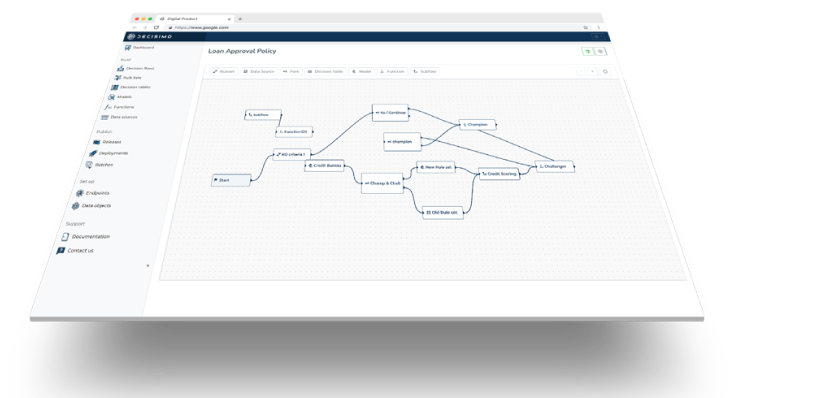
This is where deterministic decision logic matters. If you cannot explain why applications were approved, priced, referred, or declined, you cannot manage the lending system with confidence. If you can trace each rule, threshold, score contribution, and external data input, you can change policy with far less operational risk. For more on explainability and auditability, see Tracing Models and Decisions.
Start with situational awareness
Before changing policy, you need an accurate picture of the current state. Many lenders skip this step. They see one visible issue, such as lower approval rates or weaker conversion, and rush to adjust thresholds. That is risky. Lending performance is a system, not a single metric.
Situational awareness means understanding how your current decision logic performs across the full decision flow:
- Application inflow by channel, segment, geography, and product.
- Approval rate and referral rate by segment.
- Take-up and conversion after approval.
- Fraud loss, early default, and vintage performance.
- Bad rate and expected loss by score band or policy band.
- Collections inflow and recovery capacity.
- Funding demand and cash planning impact.
- Operational workload for manual review, support, and disputes.
If one of these moves, others usually move with it. For example, increasing approvals may look positive on the front end. But if it brings in weaker applicants, it may raise delinquency, increase collections load, and create more volatile funding demand. If the change also reduces margin quality, you can grow originations while weakening cash performance.
This is why lenders should track decision logic as a chain of causes and effects, not as a set of disconnected KPIs. A useful starting point is to define the current baseline for each major metric and then break results down by the parts of the policy that drive them. If you need a practical framework for lending metrics, see Metrics to Monitor in Lending and Credit Underwriting.
Define the end goal before you touch the policy
Decision strategy fails when teams optimize for a local metric instead of the business outcome. "Increase approvals" is not a strategy. "Reduce declines" is not a strategy. Those are partial outputs.
The end goal has to be explicit. In scaled lending, common end goals include:
- Grow originations within a fixed loss budget.
- Increase revenue while keeping collections inflow predictable.
- Expand into a new segment without destabilizing portfolio quality.
- Improve acceptance in a target band while preserving expected contribution margin.
- Reduce manual reviews without increasing fraud or compliance risk.
Each goal implies different decision logic. If the business wants stable growth, you may prefer narrower, more predictable policy moves. If the business wants fast expansion, you may accept controlled increases in volatility, but only if funding, collections, and monitoring are ready for it.
The key is to define success in operational and financial terms, not just approval terms. A policy that increases booked loans by 12% but pushes collections inflow up by 25% may be a bad trade. A policy that improves approval rate but makes funding requirements harder to forecast may also be a bad trade. Lending businesses need predictability, not just volume.
Think in unintended consequences and causal chains
Every policy change has downstream effects. Good decision management means mapping them before deployment. If you change one threshold, remove one decline rule, or add one new data source, ask what will happen next and what will happen after that.
A practical causal chain might look like this:
- Lower cut-off threshold.
- Approval rate increases.
- Booked volume rises.
- Average applicant quality declines.
- Early arrears increase.
- Collections inflow rises.
- Recovery teams face more workload.
- Net loss and cash volatility increase.
- Funding plans need adjustment.
That chain will not be identical in every portfolio, but the principle holds. Changes in decision logic propagate into operations and finance. If you do not model those links, you will manage lending reactively.
This is especially important when the decisioning model is unstable. Instability in decision logic creates instability in cash. If loan volumes swing unexpectedly, treasury and funding teams struggle to plan. If risk quality swings, pricing, provisioning, and collections forecasting also become less reliable. In scaled lending, consistency matters because the business has to allocate capital, staff operations, and manage liquidity with confidence.
For lenders automating approval flows, a structured approach helps prevent these failures. See Step-by-Step Guide to Automating the Loan Approval Process.
Identify the main situational levers
The core of decision engineering is understanding which levers actually move the system. Not every variable matters equally. Some rules only clean up edge cases. Others change the economics of the whole portfolio.
Main situational levers in lending often include:
- Eligibility rules such as age, residency, employment type, product fit, and application completeness.
- Affordability and capacity rules such as debt burden, disposable income, or verified cash flow.
- Risk thresholds based on scorecards, policy bands, or model outputs.
- Fraud controls that filter synthetic identity, device risk, velocity, and manipulation patterns.
- Pricing and limit assignment that shape expected return, exposure, and customer behavior.
- Manual review routing that affects operational cost and speed.
These levers do more than move a single headline number. Tightening affordability may reduce approvals, but also improve repayment stability. Relaxing an eligibility rule may increase conversion, but only in channels with weaker fraud quality. Changing pricing can alter take-up, adverse selection, and future delinquency patterns at the same time.
If your team does not know which levers drive which outcomes, it will end up making policy changes based on surface-level patterns. That is how lenders create noise instead of control. For a practical view of policy structure, see Typical Underwriting Policy in Consumer Lending and Buy Now, Pay Later and Setting up eligibility rules in credit lending.
Be careful with proxy variables
One of the biggest risks in scaled lending is treating a useful predictor as if it were a stable lever. Many model attributes are proxies. They correlate with risk, but they may also correlate with other factors you do not control.
That matters because proxy variables can break under market shifts. An attribute that works well in one period may be standing in for something else entirely, such as macroeconomic conditions, channel quality, acquisition mix, seasonality, or a partner-specific behavior pattern. When the environment changes, the model still reacts, but the business meaning of the variable has changed.
That is where problems begin. A variable may look predictive in training data, but if it is really a proxy for an external condition, it can amplify shocks instead of helping you manage them.
Examples include:
- A channel-related variable that appears to predict bad rate, but is really capturing a temporary marketing mix.
- A device or behavioral signal that correlates with fraud during one attack pattern, then loses meaning when fraud tactics shift.
- An employment-related proxy that performs well in stable markets, then moves sharply during labor market stress.
- A geographic pattern that reflects temporary economic conditions rather than durable borrower quality.
This does not mean you should avoid predictive variables. It means you should understand what they are likely proxying for, how stable that relationship is, and what happens if the environment changes. If you rely heavily on variables you do not control and cannot influence, your decision logic can blow up when those external conditions move.
That is why deterministic decision logic should support clear decomposition. You should be able to inspect rules, scores, policy bands, and external data dependencies, then test how each one affects outcomes. If needed, combine model outputs with explicit policy controls and scorecards. See Implementing scorecards in rule engines and Alternative data for credit scoring.
Prefer controllable levers over hidden correlations
A strong decision strategy favors variables and levers the business can understand, monitor, and influence. If a decision policy depends on factors outside your control, then your performance depends on forces you cannot manage.
Ask these questions about every major input in the decision flow:
- Do we know what business mechanism this input represents?
- Can we explain why it affects approval, risk, or fraud outcomes?
- Can we monitor shifts in this input over time?
- Can we influence the source of change, or are we only exposed to it?
- What happens if the relationship weakens during a market swing?
For example, affordability policy is often more controllable than a weak proxy tied to acquisition source. Verification logic is often more manageable than an opaque pattern in model output. Explicit fraud rules can be adapted faster than a hidden correlation that only becomes visible after losses rise.
This does not mean all controllable variables are better predictors. It means they are often better management tools. In scaled lending, prediction quality matters, but operational control matters too. The best decision strategy balances both.
Build management discipline around decisioning
Decisioning in lending should be managed like a production system. That means versioning, testing, tracing, and governance. Changes should not be shipped because one metric looks weak this week. They should be proposed against a defined objective, tested against expected side effects, and monitored after deployment.
At minimum, management around decision logic should include:
- Version control for rules, scorecards, and thresholds.
- Champion-challenger testing for policy changes.
- Segment-level monitoring instead of portfolio averages alone.
- Decision traces for each application and outcome.
- Feedback loops from repayments, fraud outcomes, and collections.
- Cross-functional review across risk, operations, finance, and product.
This is how you move from isolated underwriting tweaks to decision engineering. The point is not to make policy changes slower. The point is to make them safer, more explainable, and more useful to the business.
If manual underwriting is still creating noise in your process, see 7 Steps to Replace Manual Underwriting with Automated Decision Logic.
Conclusion
Decision strategy in scaled lending starts with situational awareness. Then it defines the end goal. Then it examines unintended consequences through the full causal chain, from approval policy to bad rate, collections inflow, and funding stability.
The real work of decision engineering is finding the levers that matter, separating stable drivers from weak proxies, and building decision logic around factors you can monitor and manage. In lending, unstable decisioning creates unstable operations and unstable cash. Predictable, traceable decision logic gives teams a better way to scale.
That is not about adding more complexity. It is about making each decision rule, threshold, and policy choice explicit, auditable, and tied to a business outcome.