Portfolio management in lending: what matters most
Published on: 2026-04-04 13:11:23
What portfolio management means in lending
Portfolio management is the disciplined oversight of a lender’s outstanding book. It covers performance tracking, risk segmentation, collections planning, provisioning, stress testing, and cash flow forecasting. In practice, it answers a basic question: what is happening in the book now, and what is likely to happen next?
This matters because a lending company does not manage one loan at a time. It manages a population of loans, each with different risk, age, payment behavior, and recovery patterns. The portfolio view is what turns individual credit decisions into a control system.
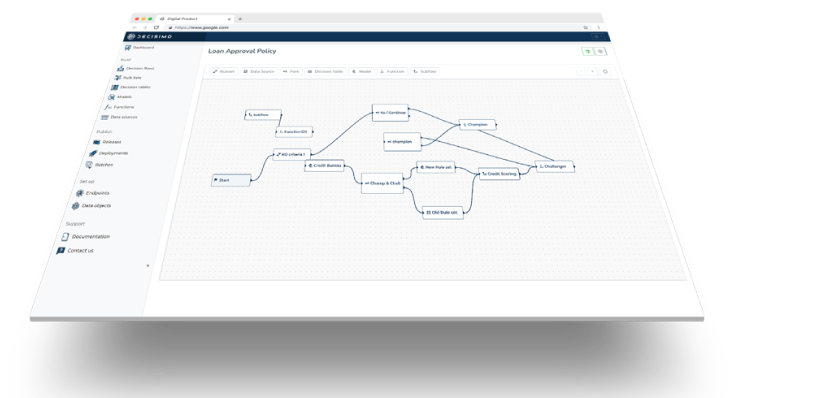
If you want the foundation behind this topic, it helps to understand what a decision engine is. Portfolio management uses the same logic discipline, but applied to an entire book rather than a single application.
What teams actually do in portfolio management
Good portfolio management is operational. The team reviews performance by product, vintage, risk band, region, channel, and servicing stage. It watches trends, compares cohorts, and decides where to tighten policy or increase capacity.
The main tasks usually include:
- Tracking delinquency and repayment performance by cohort.
- Measuring vintage curves, roll rates, cure rates, and recovery rates.
- Estimating provisioning and expected loss.
- Forecasting cash timing for servicing, funding, and capital planning.
- Planning collections staffing across delinquency stages.
- Maintaining portfolio scores for securitization and structured finance.
- Running stress tests under rate, macro, and funding shocks.
- Analyzing concentration risk by segment, geography, and industry.
None of this works if it sits in a monthly report that nobody acts on. Portfolio management needs current data, stable definitions, and decision logic that the business can trust.
Portfolio analytics: the core metrics
Portfolio analytics is the measurement layer of portfolio management. It tells you how the book behaves over time. The metrics below matter because each one reveals a different part of the risk profile.
Vintage curves
Vintage curves track performance for loans originated in the same period. They show how a cohort behaves from origination through the life of the book. A curve can show early delinquency, deterioration after month 6, or a stable repayment pattern.
They are useful because they separate origination quality from portfolio age. A bad month in originations becomes visible fast. So does a change in underwriting policy or channel quality.
Roll rates
Roll rates measure how accounts move between delinquency buckets. For example, how many accounts roll from current to 1–30 days past due, or from 1–30 to 31–60.
This metric is one of the clearest signals of portfolio drift. If roll rates worsen, the issue may be underwriting, servicing, payment behavior, or an external shock. If they improve, the book may be stabilizing.
For a practical view on how collections and risk controls interact, see why case management matters in operational control. The same logic applies in collections: stage movement must be traceable and actionable.
Recovery rates
Recovery rates measure how much value is recovered from defaulted or charged-off accounts. This includes direct collections, settlements, collateral recovery, and legal recovery where relevant.
Recovery rates are not static. They change with collection strategy, legal process, asset type, economic conditions, and recoverability of the customer base. A lender that tracks only charge-off rates is missing part of the picture.
Cure rates
Cure rates show how many delinquent accounts return to current status. This matters because not every delinquency becomes a loss. Some accounts cure quickly, some cure after intervention, and some never recover.
Cure performance helps the lender decide when to intensify collections, when to offer restructuring, and when to classify an account as unlikely to recover.
Provisioning and expected loss modeling
Provisioning translates portfolio risk into financial reserves. Expected loss models estimate how much the lender will lose based on probability of default, loss given default, exposure, and time to default.
This is one of the most important parts of portfolio management because it affects earnings, capital, and regulatory reporting. If the model is too optimistic, the business under-reserves. If it is too conservative, the business ties up capital it could use elsewhere.
In mature lending operations, expected loss is not just a finance exercise. It depends on decision logic, product design, collections effectiveness, and macro assumptions. A change in early-stage delinquency can move provisions months later.
Cash timing
Cash timing is the forecast of when repayments, recoveries, and charge-off related cash will arrive. It matters for liquidity planning, funding, warehouse facilities, and investor reporting.
A portfolio can look profitable on paper and still create cash pressure if collections are slow. That is why timing matters as much as total amount.
Collections staffing across stages
Collections staffing is a portfolio management issue, not just an operations issue. If the team understaffs a delinquency stage, accounts age faster. If it overstaffs one stage and neglects another, recoveries fall where intervention matters most.
Every stage needs enough people to handle volume, contact attempts, promise-to-pay follow-up, dispute handling, and escalation. Staffing should match the expected inflow by bucket. A portfolio that grows without collections capacity will deteriorate even if underwriting stays stable.
This is where portfolio analytics connects to operating discipline. Roll rates tell you where volume is moving. Staffing determines whether the organization can respond before accounts move deeper into delinquency.
Portfolio scoring for ABS and securitization
Portfolio scoring becomes especially important in asset-backed securities and other securitization structures. In those cases, investors need a score or rating that reflects the current quality of the entire pool, not just the score used at application.
That distinction matters. Application scores predict origination risk. Behavioral scores track account-level behavior after booking. Portfolio scores summarize the overall quality and stability of the book for funding, structuring, and investor reporting.
A portfolio score may weight delinquency, vintage behavior, concentration, recovery trends, and payment stability. It often needs to be more conservative than a borrower-level score because it is used for capital markets decisions. If you want the mechanics behind score-driven decisioning, see how scorecards work in rule engines.
Stress testing the portfolio
Stress testing asks a direct question: what happens if conditions change? A good lender does not wait for the macro cycle to turn before testing the book.
Common stress scenarios include:
- Rate increases: higher payments, weaker affordability, more delinquency.
- Credit line contraction: funding gets tighter and refinancing becomes harder.
- Business cycle downturn: unemployment rises and repayment capacity falls.
- Market disruption: asset values fall and collateral recovery weakens.
- Sector-specific shock: a concentration in one industry starts to underperform.
Stress testing should show the effect on delinquency, losses, recoveries, provisions, cash flow, and capital. A shallow test only changes one variable. A useful test shows how the whole system responds.
This is where scenario design matters. For example, a rate shock may also reduce refinance options and slow cures. A liquidity shock may not change credit quality immediately, but it can affect funding and servicing behavior. The model needs to capture the chain reaction.
Concentration analysis
Concentration analysis shows where risk is clustered. A portfolio may look diversified on total volume but still carry hidden concentration in one region, one channel, one employer group, or one industry.
That is a problem because correlated risk breaks assumptions. If several loans depend on the same economic driver, they can fail together. This can create loss spikes, collections overload, and funding pressure.
Useful concentration cuts include:
- Segment: consumer, SME, mortgage, auto, small business.
- Region: country, state, city, or local market.
- Industry: for business lending, especially in cyclical sectors.
- Channel: broker, direct, partner, marketplace.
- Risk band: low, medium, high, or internal score bands.
Concentration analysis should feed policy decisions. If one segment becomes too large, underwriting may need tighter rules, lower limits, or different pricing. If a region weakens, collections strategy may need adjustment.
What matters most in practice
The most important thing in portfolio management is not reporting more metrics. It is connecting metrics to action.
The main priorities are:
- Consistency: use stable definitions for delinquency, cure, and loss.
- Timeliness: review data before the problem compounds.
- Segmentation: compare like with like.
- Forward view: use stress testing and expected loss, not only historical loss.
- Operational capacity: match collections staffing to expected volume.
- Funding awareness: link portfolio behavior to cash timing and capital needs.
- Concentration control: avoid hidden clustering across segments and regions.
That combination is what turns portfolio management into a control function. It tells the lender where the book is strong, where it is weakening, and what action to take before losses rise.
How to structure a strong portfolio management process
A practical portfolio management process usually follows a simple cycle:
- Collect clean data from origination, servicing, collections, and finance.
- Monitor the core metrics by cohort and segment.
- Detect drift in roll rates, cures, recoveries, and cash timing.
- Run provisioning, expected loss, and stress scenarios.
- Review staffing and operational capacity by delinquency stage.
- Check concentrations across segment, region, and industry.
- Translate findings into policy, collections, pricing, or funding actions.
That cycle should run continuously, not quarterly. Lending books change too fast for static review.
Final takeaway
Portfolio management is the system that keeps a lending business understandable. It shows whether the book is behaving as expected, where risk is building, and whether the operation can absorb it.
If the team tracks vintage curves, roll rates, recovery rates, cure rates, provisioning, cash timing, staffing, portfolio scoring, stress scenarios, and concentration risk, it has the basics covered. The real value comes from using those metrics to change decision logic before the book drifts out of control.