How to Start a Consumer Lending or BNPL Business
Published on: 2026-04-05 23:46:54
Consumer lending is an operating model, not just a product
There is no single path into consumer lending. The right structure depends on what you lend, who funds it, how you acquire borrowers, and how you manage risk. A BNPL platform, a short-term lender, and a revolving credit business all use different economics, different compliance requirements, and different decision workflows.
What they share is a simple requirement: every loan decision has to be repeatable, explainable, and tied to policy. If you cannot trace why a borrower was approved, declined, priced, or routed to collections, the business will be hard to control.
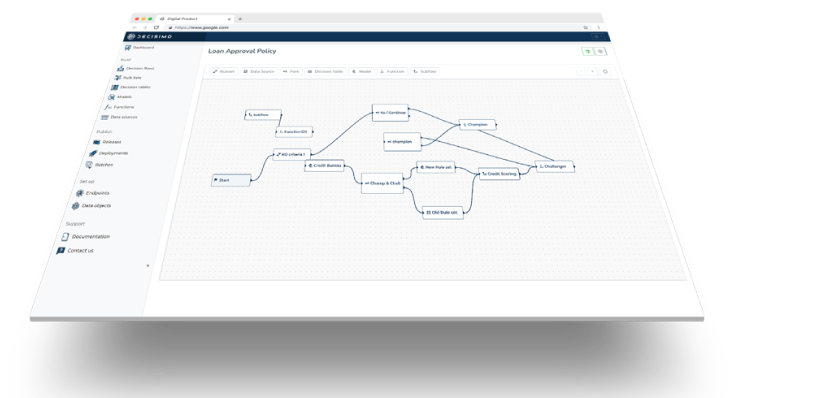
That is why the first question is not “How do we grow fast?” It is “How do we build a lending operation that can make deterministic decisions at scale?”
Understand the main consumer lending models
Consumer lending covers several product types. Each one has a different repayment profile, margin structure, and risk profile. Before you raise funding or build a platform, you need to choose the model that matches your market.
Consumer durable installment lending and BNPL
Consumer durable installment loans finance goods with a useful life of 3 years or more, such as furniture, appliances, or electronics. BNPL is a narrower version of this model. It usually splits the purchase into 3 or 4 equal payments over a short term, often weekly or bi-weekly.
BNPL works well in merchant-driven channels because it converts at the point of sale. The merchant benefits from higher basket size and higher conversion. The lender benefits from a large volume of small transactions. The challenge is control. You need fast decisions, strong fraud checks, and a clean merchant network.
Short-term installment loans
Short-term installment loans are smaller loans with terms under 1 year. In many markets, payday loans and salary loans fall into this category. They are often repaid in a single lump sum at the end of the term, which increases pressure on collections and affordability checks.
These products can produce strong returns, but they are sensitive to regulation, payment timing, and borrower cash flow. Decision logic has to be strict. If the product accepts borrowers who cannot repay on the due date, losses rise fast.
Longer-term cash loans
Longer-term cash loans usually run for more than 1 year and are repaid in monthly installments. These products spread risk over time, but they also tie up capital longer. They need stronger underwriting, more stable funding, and better portfolio management.
For this model, the underwriting policy often includes debt-to-income checks, bureau data, income verification, and a risk-based pricing layer.
Credit lines and revolving products
A credit line gives the borrower access to a limit that they can draw down over time. Interest applies only to the amount used. This model is common in cards and revolving credit products. It is more complex than a closed-end loan because utilization changes, repayment behavior changes, and the line must be monitored continuously.
If you run a revolving product, the decision engine does not stop at approval. It keeps evaluating account behavior, exposure, delinquency, and limit changes.
Get the regulatory model right first
Consumer lending is regulated in every jurisdiction. The exact rules vary, but the pattern is the same. A lender must treat borrowers fairly, disclose terms clearly, assess ability to repay, and avoid lending beyond what the borrower can reasonably handle.
Many markets also require a lending license. Some impose interest rate caps. Others require special treatment, such as Sharia-compliant structures. If you launch without checking the legal model, you can end up with a product that cannot operate.
This is not a legal detail to handle later. It shapes the product from day one.
- Disclosures: borrowers must understand the cost, term, and repayment schedule.
- Affordability: the lender must assess whether the borrower can repay.
- Rate limits: some jurisdictions cap interest or fees.
- Licensing: lending activity may require formal authorization.
- Local structure: product design may need to fit religious or consumer protection rules.
Secure funding before you scale origination
You cannot originate loans without funding. That means the business needs access to capital, either on balance sheet or through external funding partners. In practice, lenders may be banks, private equity firms, family offices, or other capital providers willing to fund loan portfolios.
There are two common structures. In one, the lender takes the loans on its own books. In the other, the lender funds a portfolio and the platform originates on its behalf. The second structure often needs tighter coordination between underwriting, servicing, and reporting.
Some businesses also explore peer-to-peer lending. In that model, retail investors fund loans directly. It can work, but the operating complexity is high. You need enough borrowers on one side and enough investors on the other. If either side dries up, the model breaks.
Funding mismatch is a real operational risk. You can have demand from borrowers and no capital. Or you can have capital and no eligible applications. Your platform needs decision logic and portfolio rules that account for both.
Build the acquisition model around your product
Once the product and funding model are clear, you need a way to find borrowers. Consumer lending businesses usually rely on one of four acquisition paths: loan comparison sites, loan origination platforms, merchant networks, or a sales force.
Loan comparison sites
Loan comparison sites present multiple loan products side by side so consumers can compare terms. Lenders usually pay for placement, leads, or successful conversions. These sites can generate volume, but they often route the same lead to multiple lenders.
That makes pre-approval logic important. If your eligibility rules are too loose, you waste time and capital on poor-fit applicants. If they are too strict, you lose volume.
Loan origination platforms
Loan origination platforms connect borrowers with lenders and often act like white-label lenders. They may present repayment information, support application processing, and manage the handoff to the funding partner.
Advanced platforms sometimes connect to a lender’s decision logic endpoint for pre-approval. That endpoint usually applies basic checks, block lists, and KO criteria before the application moves forward. This is where deterministic decisioning matters. You want every rule visible, testable, and traceable.
For a deeper look at how decision rules fit into the product, see Working with Basic Rules and Implementing scorecards in rule engines.
Merchant networks
Merchant networks are common in BNPL and consumer durable lending. Merchants promote the product at the point of sale because financing increases conversion and basket size. The lender benefits from distribution. The merchant benefits from sales growth.
This model works when the merchant network is broad, active, and disciplined. It also creates fraud exposure, because merchant behavior can vary across channels, locations, and incentives.
Sales force
Some lenders build their own sales teams. These teams may operate online, offline, at events, through referrals, or through direct outreach. A sales force can produce high lead volume and strong merchant relationships, but it is costly to maintain.
It also introduces control risk. Sales teams can misrepresent product terms, push ineligible applicants, or create fraud exposure. That is why monitoring quality matters. Mystery shopping, call reviews, and application traceability are not optional if the channel is material. For more on channel testing, see Mystery Shopping in Lending: How to Test Third-Party Sales Channels.
Design the origination flow before launch
Loan origination is the process of collecting applications, screening them, and sending eligible cases to lenders for a decision. The flow looks simple on paper. In production, it has to handle fraud checks, data enrichment, credit policy, routing, and exception handling.
- The borrower applies online or in person.
- The application is screened for eligibility.
- The system checks policy, block lists, and KO criteria.
- Eligible applications move to the lender or funding partner.
- The lender makes the credit decision.
- The borrower receives an offer.
- The documents are signed.
- The loan is funded and disbursed.
Every step should be logged. Every rule version should be tracked. Every decision trace should be available for audit and dispute handling.
If you want to see how to structure this flow, read Step-by-Step Guide to Automating the Loan Approval Process and Tracing Models and Decisions.
Service the loan after funding
Origination is only the beginning. Once the loan is funded, the business must service it. That includes collecting payments, answering borrower questions, updating accounts, and managing late payments.
Servicing is where poor operational design shows up. If payments are posted late, if customer queries are not handled, or if delinquency is not flagged early, the portfolio weakens. A good servicing stack connects payment processing, customer support, account management, and collections.
Late-stage handling matters too. The collections process starts when a borrower misses a payment. From there, the business may send notices, make calls, negotiate repayment, or hand the account to a third-party agency. In some cases, delinquent loans are sold to debt buyers.
For a structured view of this stage, see A Practical Guide to Collections Stages in Lending and Promise to Pay in Consumer Lending: How to Track, Test, and Improve Collections.
Manage risk at the portfolio level
Consumer lending businesses face credit risk, operational risk, compliance risk, reputation risk, and legal risk. These risks do not stay in separate boxes. They interact.
Credit risk grows when underwriting is weak. Operational risk grows when processes are manual. Compliance risk grows when policy is undocumented. Reputation risk grows when borrowers do not understand the product. Legal risk grows when the business operates outside local rules.
Portfolio management is the discipline that keeps these risks visible. It means reviewing performance, identifying loans that show stress, and taking action before losses widen. It also means understanding cohort behavior, repayment speed, and customer lifetime value.
A practical portfolio team watches the full lifecycle. It does not just look at approval rates. It tracks delinquencies, cure rates, roll rates, and repeat borrowing behavior. If you need a broader framework, see Portfolio management in lending: what matters most and Metrics to Monitor in Lending and Credit Underwriting.
Use decision logic to control approvals, pricing, and routing
A consumer lending platform needs more than a rules engine. It needs decision logic that can evaluate eligibility, detect fraud, apply policy, price risk, and route applications based on lender appetite. That decision logic must be explicit.
In mature setups, the lender or platform exposes a decision endpoint with pre-approval checks. That endpoint may include affordability rules, block lists, identity checks, and route selection logic. If the application passes, the lender can apply a deeper credit policy. If it fails, the system should return a clear reason.
This matters because consumer lending changes fast. Funding appetite changes. Risk moves. Regulation changes. Merchant quality changes. A hard-coded workflow becomes fragile. A configurable decision engine keeps the business moving without turning every policy update into a development project.
For more on policy design, see Decision Strategy in Scaled Lending: How to Manage Decision Logic Without Destabilizing Growth.
Plan for fraud from the start
Lending is a fraud target because it combines identity, money, and speed. Sales channels, merchant channels, and online applications all create attack surfaces. Fraud is not a side issue. It is part of the operating model.
Common control points include identity checks, device signals, address checks, email profiling, and merchant behavior checks. The right mix depends on channel risk and product value. A BNPL flow with instant approval has different controls from a longer-term cash loan with manual underwriting.
Fraud controls should be linked to decision logic, not bolted on later. When a signal changes, the platform should be able to update the rule, test the effect, and trace the decision. For related reading, see Building Anti-Fraud Competency Without Losing Control of Your Data and Antifraud investigation in lending: how to detect, trace, and validate risk.
Choose an architecture that matches the business
The usual consumer lending stack includes a customer-facing app, a merchant or sales app, a core loan origination system, payment processing, a loan approval system, a collections system, CRM, call center software, a data warehouse, and an analytics layer.
That stack only works if the systems exchange decisions and data cleanly. The loan approval system should not be a black box. It should expose decision traces, rule versions, and outcomes. The data warehouse should store enough history to support monitoring, audits, and model review.
At minimum, the architecture should support:
- borrower onboarding and application capture
- eligibility and fraud screening
- credit and pricing decisions
- loan servicing and repayment tracking
- collections and promise-to-pay workflows
- portfolio analytics and reporting
- audit trails and compliance evidence
If your team is still mapping the system, review API endpoints explained and How to implement an automated decision strategy that keeps working under failure.
Increase lifetime value without weakening risk controls
Lifetime value matters in consumer lending because acquisition is expensive. The best customers are often those who return, repay, and qualify for better products later. That is why lenders look at cross-sell and upsell paths after the first loan.
A BNPL customer may later qualify for a credit line. A cash-loan customer may later receive a higher limit. A repeat borrower may move into a lower-risk segment with better pricing. These moves can improve revenue, but only if the risk rules stay tight.
Growth should come from better decisions, not weaker policy.
What to do first
If you are building a consumer lending or BNPL business, start with the operating model. Define the product, the funding source, the regulatory constraints, and the acquisition channel. Then define the decision logic for approval, pricing, fraud, servicing, and collections.
Once those pieces are in place, the rest becomes manageable. Without them, growth will create noise, manual work, and avoidable risk.
Consumer lending scales when the process is deterministic, auditable, and aligned to the actual business model. That is the difference between a lending operation that grows and one that only looks busy.