Creating, Modifying, and Testing Business Rules in Decisimo
Published on: 2024-08-10 18:36:09
Decisimo makes decision management simpler by letting users create, modify, and test business rules without extra friction.
Our platform provides a clear interface for rule management, making it easier to implement decision logic in your business processes.
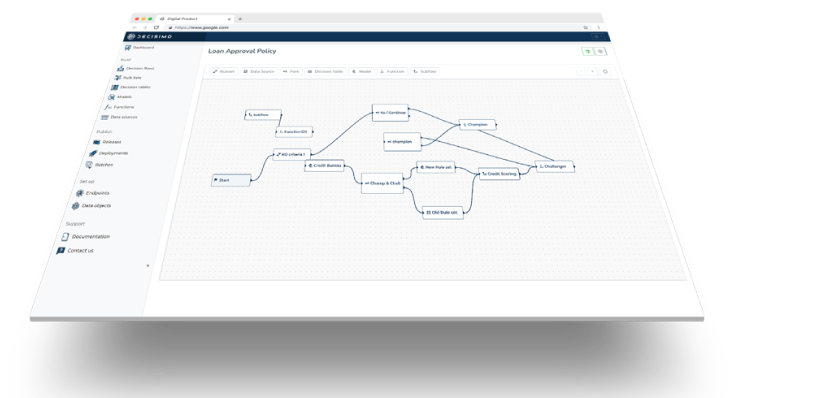
Creating and Modifying Business Rules
Creating or changing rules in Decisimo is straightforward. Users can group related rules into rulesets, each tagged with an ID and title for easy reference. Each rule has two parts: conditions and actions.
Conditions define the criteria that trigger the rule, while actions define what happens when it is triggered.
Flexible Rule Definitions
Our platform supports different condition and action definitions, from data attribute comparisons and regular expressions to direct JSON input.
You can choose from different condition operations, including text and numeric comparisons, and functions that either respect or ignore text case.
Actions can be as simple as arithmetic operations or as complex as array manipulations.
Easy Rule Management
With Decisimo, you can deactivate rules temporarily instead of deleting them. This makes it easy to test different rules without removing earlier configurations.
We also keep a history for each ruleset, so you can review past versions and track changes.
Testing Business Rules
Our platform supports in-house rule testing. Each test run is logged, and the outcomes appear in a clear, structured response field.
The response includes a sorted list of rules activated during testing, based on the input data.
Rule Sequence Adjustments
Reordering rules is a drag-and-drop operation in Decisimo. The updated sequence directly affects rule execution order, letting you improve rule configurations easily.
Keep Rules Manageable
Even with a wide feature set, it is important to avoid overly complex rules. Complex rules are harder to interpret, maintain, and can hide business logic.
It is better to break complex rules into smaller, simpler units for easier management and clearer logic.