Tracing Models and Decisions
Published on: 2026-03-09 02:23:14
Automated decisioning looks simple from the outside. A request enters the system. A decision comes out.
In production, decision systems evaluate hundreds of conditions, rules, and data transformations before returning a result. Without proper tracing, no one can answer a basic question:
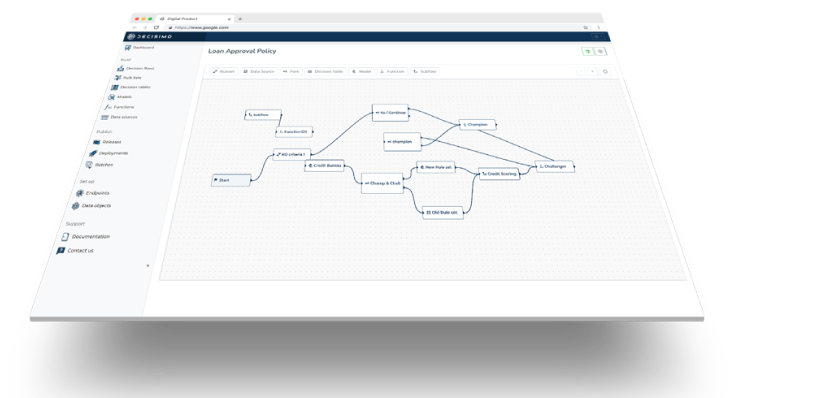
Why did the system reach this decision?
Banks, fintechs, and insurers face this question every day. Regulators ask it. Risk teams ask it. Customers ask it.
The answer requires full decision traceability across the entire decision flow.
This article explains what tracing means in practice and how it applies to different stages of automated decision logic.
What a Decision Trace Actually Is
A decision trace records the full path a decision took through the system.
This includes:
- input data used in evaluation
- rules evaluated and their outcomes
- intermediate calculations
- external API responses
- final decision result
Every step becomes part of an auditable record.
A proper trace lets a team reconstruct a decision months later and show exactly how the logic executed.
In regulated industries, this is not optional. Regulations such as GDPR and DORA require explainability for automated decisions that affect customers.
Stage 1: Input Data Evaluation
Every automated decision starts with input data.
Examples include:
- loan application data
- bank account transaction history
- identity verification results
- credit bureau responses
- internal risk scores
Before any business rules run, the system checks data quality and structure.
Typical checks include:
- missing fields
- invalid formats
- inconsistent values
- stale data
A trace should record:
- the raw inputs received
- any transformations applied
- validation results
Input: Monthly income = 4,200
Source: application form
Validation: passed
Transformation: converted to integer
Without this step, teams cannot tell whether a decision failed because of bad input or because of rule logic.
Stage 2: Decision Logic Execution
Once inputs are validated, the system executes the decision logic.
This logic usually consists of:
- decision trees
- decision tables
- rulesets
- conditional logic
- score calculations
Example underwriting logic might include rules such as:
IF credit_score < 580
THEN reject application
IF debt_to_income_ratio > 45%
THEN mark for manual review
A decision trace records:
- each rule evaluated
- the result of the rule
- the order of execution
Rule: credit_score_check
Condition: credit_score < 580
Result: false

Rule: debt_to_income_check
Condition: debt_to_income_ratio > 45%
Result: true
Outcome: manual review
This trace explains the decision in exact terms.
Stage 3: External Data and API Orchestration
Modern decision workflows rarely rely on internal data alone.
They often call external services such as:
- credit bureaus
- fraud detection systems
- bank account aggregation APIs
- identity verification providers
Each call affects the decision flow.
Example sequence:
- Retrieve bank transaction history
- Calculate income stability
- Run fraud signals
- Update risk score
A proper trace records:
- the API endpoint called
- request parameters
- response data
- evaluation results
API call: transaction_analysis_service
Transactions analyzed: 540
Detected monthly income: 4,180
Income stability score: 0.87
If an external service fails or returns unexpected data, the trace shows the exact point of failure.
Stage 4: Derived Metrics and Model Outputs
Many decision systems calculate derived metrics before making a final decision.
Examples include:
- debt-to-income ratio
- transaction volatility
- revenue trend for business accounts
- fraud risk score
- affordability score
These calculations often combine several inputs.
Debt-to-income ratio
= total monthly obligations / verified income
= 1,950 / 4,180
= 46.6%
The trace must include:
- formulas used
- intermediate values
- final metric results
This lets risk teams verify that calculations behaved as expected.
Stage 5: Final Decision and Outcome
After evaluating rules, data, and derived metrics, the system returns a decision.
Typical outcomes include:
- approve
- reject
- manual review
- request additional information
The trace records:
- the final decision
- the rule or condition that triggered it
- the ruleset version used
Decision: manual_review
Triggered by: debt_to_income_check
Ruleset version: v3.14
Timestamp: 2026-03-09T10:32:14
Version tracking matters. Decision logic changes over time. A trace must link each decision to the exact version of the rules active at that moment.
Stage 6: Post-Decision Analysis
Tracing does not stop after the decision.
Organizations analyze traces to improve performance and risk models.
Decision distribution
Example questions:
- What percentage of applications go to manual review?
- Which rules reject the most applications?
Rule effectiveness
Teams analyze which rules trigger most often and whether they produce correct outcomes.
Rule: income_instability_flag
Triggered: 22% of cases
Manual review outcome: 81% rejection
Model monitoring
If a model feeds into decision logic, traces help detect drift.
Example signals:
- risk score distribution changes
- unusual increase in fraud flags
- sudden approval spikes
Without trace data, diagnosing these shifts becomes difficult.
Why Traceability Matters
Many systems can produce decisions. Few can explain them.
Traceability gives teams three operational advantages.
1. Audit readiness
Regulators often request proof that decisions follow documented rules. A decision trace provides exactly that.
2. Faster debugging
When a decision looks wrong, teams can inspect the trace and see which rule fired and which data triggered it.
3. Safer rule changes
Trace history lets teams compare decisions before and after rule changes.
Deterministic Decisions vs Black Box Models
Many organizations use machine learning models inside decision flows. These models often act as black boxes.
Deterministic decision logic keeps the final decision explainable. Models may provide signals, but rules determine the outcome.
IF fraud_model_score > 0.82
AND transaction_velocity > threshold
THEN reject payment
The model produces a signal. Decision logic interprets it. The trace records both steps.
The Operational Standard for Decision Systems
For automated decisioning to work in production environments, four properties matter:
- Determinism
- Traceability
- Explainability
- Version control
Without these properties, automated decisions become hard to trust.
Final Thought
Automation increases decision volume. Banks and fintechs now run millions of automated evaluations every month.
Without proper tracing, those decisions become opaque.
With traceability, teams can reconstruct the exact execution path of any decision and explain it months later.
That is the difference between automated decisions and auditable decision systems.