Why Decision Lineage Matters in Chained Decision Flows
Published on: 2026-04-11 18:06:18
Decision flows are getting longer
Decisioning used to be simpler. A decision table ran. A ruleset fired. The system returned an outcome.
That model still exists, but it is no longer the norm in many lending, fintech, and fraud operations. Today, a single decision flow can include multiple artifacts, external data calls, segment logic, champion-challenger splits, and fallback paths. Tools like n8n have made step-based orchestration more visible, which is useful. It also exposes a harder problem: the decision trace is no longer enough on its own.
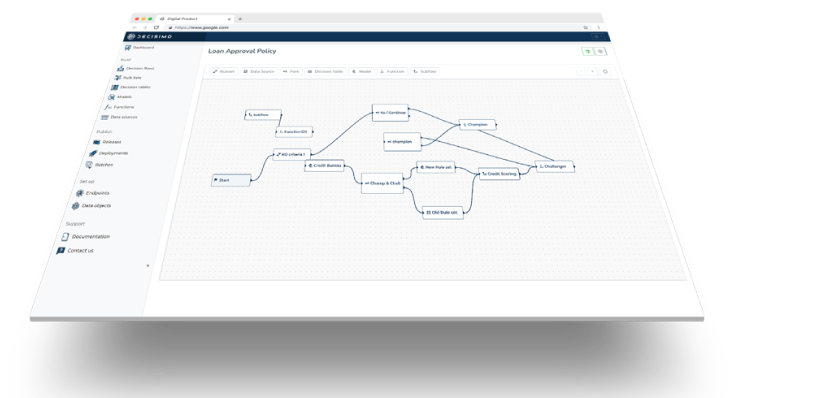
When decisions are chained, the data can change between steps. A third-party check may return later than expected. A rule may activate only after a prior condition is met. A step may run more than once. The final outcome can still be deterministic, but the path to that outcome is more complex.
Trace is not the same as lineage
Many teams already capture logs. They know which step ran, when it ran, and what output it returned. That is a trace. It tells you what happened.
Decision lineage goes further. It records the state of the decision logic and the data at each step. It shows not only that a rule fired, but also what data it saw, what inputs changed, and what version of the ruleset or model influenced the result.
This matters because the same decision flow can behave differently depending on order, timing, and data arrival. If you only keep the trace, you may know that a step executed. You may not know why it executed, what it evaluated against, or how the state had changed before it ran.
Why lineage matters in complex decision logic
Decision intelligence is about understanding how data at decision points affects the final decision. That is hard enough in a simple ruleset. It becomes much harder when several decision artifacts interact.
Here is where lineage becomes important:
- Data arrives at different times. One source may respond immediately, another may update later.
- Rules activate conditionally. A rule can sit idle until a prior step changes the segment or risk band.
- Artifacts repeat. A scoring step, enrichment call, or validation check may run more than once.
- Decision paths split. Champion-challenger logic can send similar cases into different routes.
- State changes during execution. A field that looked true at step 2 may be false by step 5.
Without lineage, a team can explain the final outcome in broad terms. With lineage, they can explain the sequence that led there.
What to capture at each decision step
If you want a decision flow to stay explainable, you need more than an event log. You need a snapshot at each meaningful step. That snapshot should answer three questions.
1. What data was available?
Capture the input state at the moment the step ran. That includes customer attributes, external data, prior step outputs, and any transformed fields used by the decision logic.
2. What logic was evaluated?
Record the ruleset, decision table, model, or branching condition that ran. If the step used versioned logic, store the version.
3. What changed after the step?
Track output fields, new flags, score changes, routing changes, and any updated decision state. If a later step depends on that change, the lineage must show it.
This is the difference between saying, “the fraud check ran,” and saying, “the fraud check ran after enrichment changed the country field, which activated a different rule path.”
A simple trace can miss the real cause
Suppose a loan application passes an initial affordability check, then fails a later manual review rule. A basic trace might show the review step as the failure point. That is not enough.
The lineage may show that the applicant’s income was updated by a third-party source, which moved the case into a different segment. That segment triggered a stricter policy. The review step did not create the problem. It exposed it.
That is why a decision engineer has to think in terms of state, not just steps. The business user does not need every internal detail. They do need a clear answer to what changed, when it changed, and why that changed the final outcome.
Where lineage helps the most
Decision lineage becomes most useful when decision logic is chained across multiple systems and teams. The more moving parts you have, the more valuable the snapshot becomes.
- Underwriting flows with external data, scorecards, and policy rules.
- Fraud flows with device signals, identity checks, and watchlist checks.
- Collections flows with segmentation, promise-to-pay logic, and retry paths.
- Pricing flows with risk-based pricing, product rules, and exception handling.
- Experimentation flows with champion-challenger split logic and outcome comparison.
In each of these cases, the decision trace alone can be too thin. You need the data state at each stage to explain the final result with confidence.
Decision lineage supports better change management
Lineage is not only a debugging tool. It is also a control mechanism for change.
If you change the order of steps, alter a ruleset, or add a new data source, lineage gives you a baseline. You can compare what happened before and after the change. You can see whether a new branch activated earlier than expected. You can see whether the same case would have moved differently with a different data order.
That matters for teams that manage live decision logic. A small change in sequence can produce a different outcome, even when the final rules appear unchanged. Lineage makes that visible.
What a decision engineer needs to explain
The person owning the decision logic has to answer fast, clear questions from business users, compliance teams, and operations teams.
Typical questions include:
- Why did this applicant get this outcome?
- Which step changed the segment?
- What data arrived after the first check?
- Which rule version was active?
- Would the outcome have changed if the steps ran in a different order?
Those questions are hard to answer with raw logs alone. They are much easier when every decision step has a state snapshot and a trace of how that state evolved.
How to think about lineage in practice
A useful decision lineage model does not need to be complicated. It needs to be consistent.
For each meaningful decision step, store:
- the input state
- the logic version
- the output state
- the timestamp
- the source of any external data
- the branch taken, if applicable
That gives you a replayable path. It also lets you compare the decision as executed with the decision as designed.
If you already use decision tables, rulesets, models, or API orchestrations, this is the next layer. It is what makes decision logic auditable once the flow stops being linear.
Why this matters for explainability
Explainability is not only a compliance requirement. It is an engineering requirement. If you cannot explain a decision flow, you cannot reliably operate it.
Lineage gives you the evidence. It shows how data changed, which rules activated, and which steps influenced the result. That is the basis for a clear explanation. It also helps teams spot weak points in the flow, where a late-arriving signal or repeated artifact execution may be creating avoidable variance.
For lenders, insurers, and fintechs, this is the difference between a system that works in production and a system that only looks understandable in a diagram.
Decision flows will keep getting more complex
The trend is clear. More teams are chaining decision artifacts together. More flows include external data. More logic is split across orchestration, rules, and models.
That is useful. It also means decision trace alone is no longer enough. If you want to understand why a flow produced a result, you need decision lineage. You need to know what the state looked like at each step, not just which steps executed.
That is the only way to explain a complex decision with confidence, test changes safely, and keep decision logic under control as the flow grows.
When the flow is simple, a trace may be enough. When the flow is chained, lineage is what keeps the decision understandable.
If you want to see how decision logic can stay traceable as flows get more complex, start with the foundation: Tracing Models and Decisions and Working with Basic Rules.