Published on: 2024-08-10 19:01:13
Lenders set interest rates in two ways. Product-driven pricing, or a risk-based rate for each customer.
Product-driven pricing gives every customer the same rate for a given product. You can estimate product profitability as the average expected risk cost per loan in that portfolio.
Risk-based pricing sets a rate for each customer based on the probability of default.
This approach lets you differentiate rates to improve profitability and remain competitive. It is harder to execute because you need to understand each customer's risk.
Risk-Adjusted Return on Capital
Some lenders calculate Risk-Adjusted Return on Capital (RAROC) for each customer and set the rate from that result. RAROC can also include customer lifetime value, including potential cross-sell and upsell.
Risk-based pricing is complex because the formulas used to calculate RAROC can change and may include multiple models.
The models used in RAROC can include
- Anti-fraud model: the probability of fraud
- Credit risk model: the probability of credit risk
- Cross-sell and upsell propensity model: the probability of accepting an offer
Complexity also comes from different customer segmentation by demographics.
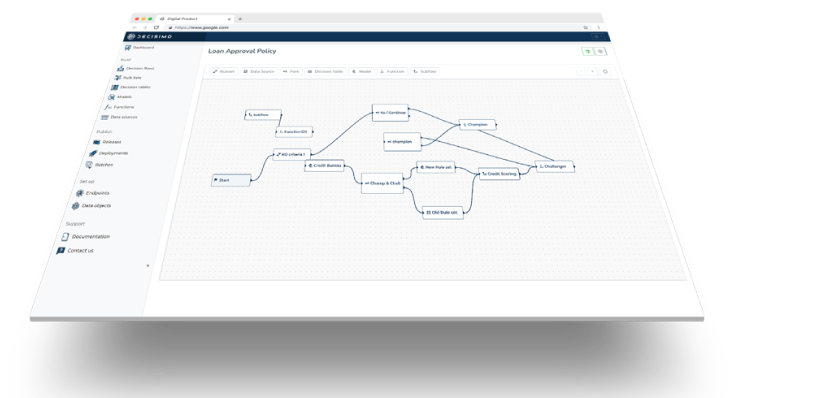
In practice, full risk-based pricing can sit as a sub-flow within the underwriting decision flow.
Related Articles
-
Metrics to Monitor in Lending and Credit Underwriting
Speed and conversion metrics shape how well a lender performs in underwriting. If you do not track the right ones, you can miss friction in the application flow, delay funding, and lose good customers before they reach a decision. This article explains four core underwriting metrics, how they differ, and why improving them gives lenders a real competitive edge.
-
Credit risk strategy in micro-lending
Micro-lenders face specific credit risks that demand a focused, operational strategy to cut default probability and improve repayment. This article defines four core risk groups (business, country, sector, borrower) and lays out practical controls: structured credit analysis, personal guarantees and collateral, LTV and term limits, risk-based pricing, portfolio reviews, provisioning, collections, and selective use of alternative data. It also shows how to encode these policies as auditable decision logic.
-
When to Set Up Credit Scoring in Lending
New lenders often reach for a scorecard too early. That usually creates weak approvals, false rejects, and higher acquisition cost before the model has enough data to help.
In market entry, antifraud comes first. Credit scoring matters later, when you have enough performance data to separate risk, reduce hard rules, and raise approval rates without weakening the book.
-
Why BNPL Changes the Economics of Consumer Finance
Consumer finance has always depended on a simple idea: lend against something that creates value or preserves access to value. Buy now, pay later changes that model. It combines parts of installment lending, revolving credit, and merchant finance, but it also changes the risk profile, the economics, and the operating model.
This article looks at consumer finance through the lens of business model design, credit risk, fraud risk, portfolio risk, operational risk, and return on capital.
-
Deployment of Risk Management Decision Engines in Consumer Lending
Consumer lending decision engines need a clear rule order, flexible control, and full traceability. This article explains how to structure decision logic so teams can manage risk, save cost, and adapt quickly as data changes.