Merchant Risk Evaluation for BNPL and Consumer Lending
Published on: 2026-04-07 11:49:36
Merchant risk evaluation is a control point
In BNPL and consumer lending, merchants are not just sales partners. They are the point where fraud, weak underwriting, and bad operational controls often start. If the merchant network grows faster than the risk process, the portfolio inherits that weakness.
This is why merchant risk evaluation needs to be built as a decision flow, not a manual checklist. The goal is simple: approve good merchants quickly, block bad ones early, and keep watching the ones that pass initial checks.
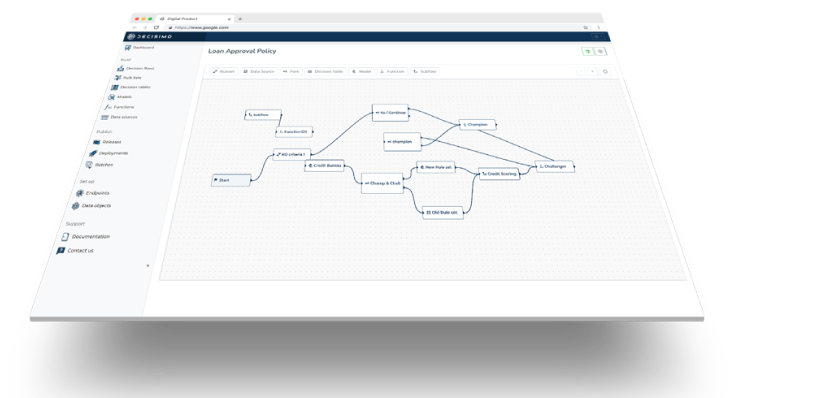
That process has 3 parts: business evaluation, credit risk evaluation, and manual review or store visit. The first 2 steps can usually be automated. The last one still matters, especially where company records are incomplete or informal trading is common.
1. Business evaluation: confirm the merchant exists and is operating properly
The first question is basic. Does this merchant exist as a real business, and does it meet the filing and registration standards required in its country?
Business evaluation should cover:
- Business registration status
- Ownership structure
- Filing history
- Reporting compliance
- Basic consistency between declared and registered information
This step is often the easiest to automate. A company registrar can answer a lot of questions fast, including whether the company is active, who owns it, and whether it is filing required documents on time.
For example, in the UK, a registrar such as Companies House can be queried as part of the decision logic. That lets a platform verify company existence and check whether filings are current, so it need not wait for a manual analyst.
Automation here matters because merchant onboarding needs scale. A financing provider may need to evaluate hundreds or thousands of merchants, and manual checks alone will create a bottleneck. A deterministic ruleset can handle the first pass, then route exceptions to review.
What counts as a red flag in business evaluation
Not every issue is fatal. But some signals should trigger a stop, not a lower score.
- The company is not registered or cannot be matched reliably
- Required filings are missing or long overdue
- Ownership details are unclear or inconsistent
- The business status does not match the merchant’s claim
- The company shows signs of repeated restructuring without a clear reason
These are not minor data quality issues. They often point to a business that cannot be traced cleanly, which creates operational and fraud risk later.
2. Credit risk evaluation: assess the business and its owners
Once the business check passes, the next step is credit risk evaluation. This means checking the credit profile of the company and, where relevant, its owners or directors.
In merchant financing, this step matters because fraud is often linked to financial stress. Merchants that are already under pressure are more likely to misstate sales, push bad transactions, or use financing products in ways that increase losses. A deteriorating financial position can show up before the fraud is obvious.
Credit evaluation can usually be automated through bureau integrations. The platform queries the bureau, pulls the business and owner credit history, then evaluates those results against explicit rules. If the result crosses a threshold, the application is rejected or sent for manual review.
That is the right approach. Early warning signs in a credit check should usually be treated as a KO criterion, not as a soft scoring input. If a merchant or owner already shows serious distress, the safest decision is often to stop the relationship before capital is exposed.
Examples of credit risk signals that should matter
- Recent delinquency or default history
- County court judgments or similar adverse records
- Evidence of insolvency, restructuring, or collections pressure
- Repeated adverse changes in the owner’s credit profile
- Weak or deteriorating business credit history
These signals do not prove fraud on their own. But they do show a higher probability that the merchant will become a loss source. In merchant risk, that is enough to justify a hard stop or a more conservative approval path.
If you are building a broader merchant decision flow, it helps to think about the same approach used in other risk domains. A strong ruleset does not average risk. It blocks unacceptable cases early. That same logic appears in decision strategy in scaled lending, where growth only works when decision logic stays controlled.
3. Manual review and store visit: verify the merchant in the real world
Manual review is slower, but it still has a place. It matters most in countries with large informal economies, or when company filings are stale, incomplete, or hard to trust.
The main goal of this step is simple: confirm that the store exists and operates as claimed. A manual analyst or field agent can inspect the location, verify signage, check trading activity, and compare what is visible on site with the information provided in onboarding.
In some cases, this step can be partly automated. If the merchant has a strong Google Maps presence, with a verified location, images, reviews, and consistent business information, that can reduce the need for a physical visit. It does not replace review in all cases, but it can narrow the queue.
What a manual review should verify
- The store exists at the stated location
- The business name matches the application
- Trading activity looks consistent with the application
- The location appears open, staffed, and legitimate
- Any visible risk signals are documented clearly
Manual review should produce traceable evidence. Photos, notes, timestamps, and reviewer comments should all be logged. If the store visit becomes part of the approval logic, it should be auditable later.
Make the approval flow scalable
Merchant onboarding fails when every case is treated the same. A good process separates standard cases from exceptions.
That usually means three routing paths:
- Auto-approve for merchants that pass business and credit checks cleanly
- Auto-reject for merchants with serious adverse findings
- Manual review for borderline cases, incomplete records, or higher-risk countries
This structure keeps the network growing and preserves control. It also makes the process easier to audit, because every decision has a reason tied to a rule or reviewer action.
Scalability depends on data quality. The better your sources, the more you can automate. That is why a merchant decision flow often combines registrar data, bureau data, geolocation, and internal rules. When those sources are connected, the platform can evaluate risk in minutes instead of days.
If you are mapping the data layer behind this process, it helps to review data sources you can use and how they fit into a deterministic decision model. The point is not to collect more data for its own sake. The point is to use the right data at the right step.
Post-approval monitoring is where weak merchants show themselves
Initial approval is only the beginning. After onboarding, financing companies should monitor merchant behavior and the performance of loans issued through each store.
This is where problems often become visible. A merchant that looked fine at onboarding may later show signs of distress, abnormal refund patterns, weak repayment performance, or unusual loan concentration at a specific location.
Monitoring should cover both the merchant and the portfolio attached to that merchant. If one store starts producing worse loans than the rest, that is a signal. If several stores under the same owner show similar behavior, that is a stronger signal.
Signals to monitor after approval
- Loan delinquency by store
- Refund or cancellation rates
- Chargeback or dispute patterns
- Abnormal sales concentration
- Changes in credit profile
- New adverse information from external sources
Any red flag should be evaluated. In some cases, the right action is tighter limits. In others, it is more scrutiny, a repeat store visit, or mystery shopping to test whether the merchant is still operating as expected.
That is especially relevant when a store begins to look riskier after approval. The correct response is not to ignore the signal because the merchant already passed onboarding. It is to route the case back through decision logic and decide whether the exposure should stay, shrink, or stop.
For teams building this kind of process, ongoing control often depends on tracing decisions and model inputs over time. A useful reference is Tracing Models and Decisions, which shows why post-decision auditability matters as much as initial approval.
A practical merchant risk framework
A workable merchant risk process does not need to be complicated. It needs to be explicit.
Start with business verification. Then check credit risk. Then use manual review only when the automated evidence is not enough. After approval, keep monitoring the merchant and the loans tied to that merchant.
The core rules are straightforward:
- Verify the merchant exists
- Check whether the business is properly registered and filing as required
- Evaluate business and owner credit risk
- Treat serious adverse findings as KO criteria
- Use manual review for cases that data cannot resolve
- Monitor performance after approval
- Escalate when red flags appear
That is the logic behind a scalable merchant risk program. It protects growth and does not pretend every merchant is the same. It also creates a clear audit trail, which matters when the business must explain why a merchant was approved, rejected, or later restricted.
In BNPL and consumer lending, merchants are the frontier of fraud-fighting. The firms that manage that frontier well do 2 things at once. They automate the repeatable checks, and they keep human scrutiny where judgment still matters.