A Practical Map of Credit Risk: What Actually Affects Loan Performance
Published on: 2026-03-28 22:06:45
When lenders talk about credit risk, they often mean one thing: the probability that a borrower will not repay as agreed. That definition is correct, but it is too narrow for real operations.
In a live lending business, credit risk sits inside a broader risk system. Borrower affordability matters, but so do fraud controls, funding stability, collections execution and capacity, technical reliability, and regulatory discipline. Weakness in any of these areas can worsen portfolio performance, even if the underwriting policy looks sound on paper.
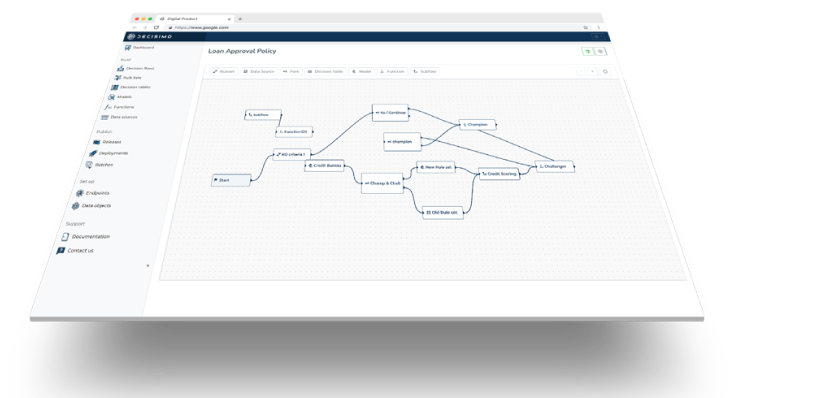
A more useful view is to treat credit risk as the center of a map. Around it are connected risks that can increase losses directly or indirectly. If you want predictable outcomes, you need decision logic that makes those connections visible, testable, and auditable.
This article lays out that map in practical terms.
Credit risk is the core, but not the whole picture
At the center is credit risk. This is the risk that a borrower fails to meet contractual obligations, pays late, restructures, or defaults. In most lending models, credit risk is shaped by a few familiar drivers:
- Income stability and affordability
- Debt burden and repayment capacity
- Credit history and prior delinquencies
- Employment profile or business cash flow
- Collateral quality, if secured
- Product structure, term, pricing, and repayment schedule
- Macroeconomic conditions
Those drivers matter. But portfolio losses rarely come from pure borrower behavior alone. Losses often rise because the lender approved the wrong cases, failed to detect fraud, funded the book poorly, or lacked the collections capacity to act fast when conditions changed.
That is why credit risk should be mapped together with adjacent risks. For teams building automated decision logic, this matters even more. You do not just need a score or policy. You need a decision flow that reflects how risks interact across origination, servicing, and collections.
If you want a detailed view of lending metrics that sit underneath this process, see Metrics to Monitor in Lending and Credit Underwriting.
1. Underwriting risk: weak approval logic creates future losses
One of the closest risks to credit risk is underwriting risk. This is the risk that your approval policy, scorecards, affordability checks, or pricing logic do not separate good cases from bad ones well enough.
Typical causes include:
- Overreliance on outdated credit models
- Poor use of bureau and alternative data
- Rules that drift over time without review
- Affordability logic that ignores real expense pressure
- Policy exceptions handled outside the platform
- Inconsistent treatment of segments, channels, or geographies
Underwriting risk becomes credit risk later. A loan that should have been declined shows up months later as arrears, restructuring, or charge-off. If enough of those cases get through, vintage performance deteriorates and collections starts carrying a problem that started upstream.
This is one reason to keep decision logic explicit and versioned. Teams need to know which policy approved which borrower, under what rules, and with what data inputs. That is the basis of traceability and policy review. For more on that, see Tracing Models and Decisions.
2. Fraud risk: not every bad loan is a bad credit decision
Fraud risk is often mixed up with credit risk, but the two are different. A borrower who cannot repay is not the same as an applicant who never intended to repay, used stolen identity data, manipulated documents, or created a synthetic profile.
If fraud controls are weak, a lender will misread fraud losses as credit deterioration. That leads to the wrong response. Tightening credit policy may reduce approvals, but it will not fix identity fraud, account takeover, first-party fraud, or application manipulation.
Fraud affects credit risk in several ways:
- Fraudulent applications inflate default rates
- Synthetic identities distort portfolio analytics
- Document tampering weakens affordability assessment
- First-party fraud raises early delinquency and bust-out losses
- Weak investigation capability allows repeat attacks
Prevention matters, but so do investigation and discovery powers. If teams cannot trace device signals, identity checks, velocity rules, linked applications, or external data responses, they cannot explain why losses are rising or adapt decision rules quickly.
For a deeper look at fraud controls in lending, read The True Nature of Fraud and How to Build Anti-Fraud That Works and Prevent identity and synthetic fraud in consumer lending.
3. Operational risk: good policy fails when execution is weak
Operational risk is the risk of loss caused by failed internal processes, human error, poor controls, or weak execution. In lending, this can affect credit outcomes more than many teams expect.
Examples include:
- Manual review queues that create delays and inconsistency
- Missing documents or poorly verified application data
- Collections workflows that do not trigger on time
- Payment reconciliation errors
- Bad handoffs between underwriting, servicing, and recoveries
- Untracked policy overrides
Operational risk damages credit performance because it changes borrower treatment. A solid approval can become a weak account if onboarding fails, disbursement creates confusion, payment plans are not administered properly, or collections intervention arrives too late.
This is one reason many lenders move toward automated decision workflows. Consistent execution reduces variation and makes policy outcomes easier to audit. If you are looking at that transition, see 7 Steps to Replace Manual Underwriting with Automated Decision Logic and Step-by-Step Guide to Automating the Loan Approval Process.
4. Collections capacity risk: losses rise when recovery capability cannot absorb the book
Collections capacity risk is the risk that the lender does not have enough operational, analytical, legal, or vendor capacity to manage delinquent accounts effectively as the portfolio grows or deteriorates.
This is close to operational risk, but it is specific enough to stand on its own. A lender may have sound underwriting, stable systems, and clear collections policies, yet still suffer higher losses because collections resources are overloaded, poorly segmented, or unable to act with enough speed and precision.
Typical causes include:
- Delinquent account volumes rising faster than internal collections headcount
- Weak segmentation of treatment paths by risk, balance, product, or customer profile
- Inadequate dialer, workflow, or case management capacity
- Limited legal or external agency capacity for later-stage recoveries
- Poor contactability data or weak borrower communication infrastructure
- Collections strategies that are not recalibrated as the portfolio mix changes
- Insufficient monitoring of cure rates, roll rates, recovery timing, and agent productivity
Collections capacity risk affects credit outcomes directly. When teams cannot contact borrowers fast enough, apply the right treatment at the right stage, or escalate accounts efficiently, arrears harden and recoveries fall. The result is not just delayed cash flow, but higher lifetime loss.
This risk becomes more visible during stress. A book that performs acceptably in benign conditions can deteriorate sharply when delinquency inflow exceeds collections handling capacity. In that situation, even a temporary backlog can change portfolio economics, because missed early intervention often leads to worse downstream outcomes.
For that reason, collections should not be viewed only as a downstream function. It is part of credit performance. Approval strategy, product structure, borrower communication, and collections capacity need to be aligned. If the lender originates faster than it can service and recover, portfolio risk is understated at origination.
5. Liquidity risk: funding pressure changes credit behavior fast
Liquidity risk is the risk that a lender cannot access funding on acceptable terms when it needs to. This may look separate from credit risk, but in practice the two are tightly linked.
When liquidity tightens, lenders often react by changing credit policy quickly. Approval cutoffs rise. Credit lines shrink. Pricing changes. Collections pressure increases. Renewal strategy shifts. All of this affects both customer behavior and portfolio performance.
Liquidity pressure can come from several sources:
- Warehouse lenders checking covenants more aggressively
- Delayed funding tranches
- Investors stepping back from new originations
- P2P marketplace lenders seeing deals fill more slowly
- Higher cost of capital reducing product viability
In a P2P or marketplace model, perception matters a lot. If retail or institutional investors become concerned about platform quality, underwriting discipline, or solvency, capital can slow down before any formal failure occurs. That can force abrupt changes in origination and servicing strategy.
Liquidity stress can also worsen collections. Borrowers who think a lender is unstable may assume enforcement will weaken. Some may infer, correctly or not, that the company is distracted or under pressure, and that non-payment has lower immediate consequence.
So while liquidity risk is not credit risk in the narrow sense, it directly affects the environment in which credit decisions perform.
6. Reputation risk: trust affects repayment, funding, and fraud pressure
Reputation risk, or PR risk, is often treated as a communications issue. It is more than that. For lenders, trust influences repayment behavior, investor confidence, partner support, and even fraud pressure.
A reputational event can come from poor customer treatment, regulatory scrutiny, service outages, unfair collections practices, data incidents, or negative media coverage. Once trust falls, several things can happen:
- Borrowers become less cooperative in collections
- Partners review exposure and tighten terms
- Liquidity providers slow funding or revisit covenants
- Investors hesitate to support new originations
- Fraudsters target the lender if they sense weak controls
This matters because collections performance is partly behavioral. People do not repay only because they can. They repay because they believe the contract matters, the lender is legitimate, and the process will continue. If reputation weakens, repayment discipline can weaken too.
That link is easy to miss in portfolio analysis. A rise in delinquency may not come only from affordability stress. It may come from a broader loss of confidence in the institution.
7. Technical risk: weak systems produce bad decisions and bad outcomes
Technical risk is the risk created by unstable systems, poor integrations, outages, data quality failures, or weak engineering controls. In automated lending, technical risk can shape credit performance at every stage.
Examples include:
- Decision engine downtime during peak application periods
- Broken API orchestrations to bureaus, KYC, or fraud providers
- Missing or stale data in decision tables
- Production changes deployed without testing
- Rule versions not tracked properly
- Monitoring gaps that hide approval anomalies
These are not just IT issues. If an income verification integration fails, a lender may approve cases using incomplete data. If fraud checks time out and fall back badly, risky applications may pass. If collections triggers fail, arrears treatment may start late. Technical risk becomes credit risk through decision quality and execution quality.
This is why deterministic decision logic matters. Every rule, fallback, external call, and exception path should be visible and testable. Teams should be able to trace exactly what happened on each application or account event. For more on resilient decision design, see How to Implement an Automated Decision Strategy That Keeps Working Under Failure.
8. Regulatory risk: compliance failures feed back into portfolio risk
Regulatory risk is the risk of enforcement action, remediation cost, operational restriction, or reputational damage caused by non-compliance. In lending, this is closely tied to decision quality.
Weak compliance operations can affect credit outcomes in several ways:
- Affordability and suitability standards are applied inconsistently
- Adverse action reasons are not explainable
- Collections practices breach local rules
- Data use exceeds consent or legal basis
- Model governance and policy approvals are not documented
- Complaints and disputes expose policy defects
Regulatory pressure rarely stays in the compliance team. It spills into underwriting policy, servicing operations, board oversight, and funding relationships. Remediation programs slow delivery. Manual controls increase. Product changes stall. Trust falls.
For lenders operating in regulated markets, explainability and auditability are not optional. Decision logic needs clear rules, version control, traceability, and evidence. That is how teams show what happened, why it happened, and which policy was active at the time.
9. Concentration risk and macro risk: external shocks expose internal weaknesses
Two more categories belong on any practical map of credit risk.
Concentration risk is the risk created by too much exposure to one segment, employer group, geography, product type, merchant, broker channel, or funding source. A portfolio can look healthy until one concentrated area turns.
Macro risk comes from inflation, unemployment, interest rate shifts, housing changes, sector downturns, and broader consumer stress. These drivers affect repayment capacity directly, but they also expose weak policy design. A credit strategy that performs only in benign conditions is not a durable strategy.
The interaction matters. A lender concentrated in a fragile segment may see losses rise much faster than peers during a downturn. That is not just bad luck. It is a portfolio construction issue.
How these risks connect in practice
The key point is not to list risks in isolation. It is to understand the links between them.
- Weak fraud controls can look like poor credit quality
- Bad technical operations can produce faulty underwriting
- Operational failures can weaken servicing and collections
- Collections capacity shortfalls can turn manageable delinquency into higher charge-off and lower recovery
- Reputation damage can reduce repayment discipline
- Liquidity pressure can force policy changes that distort portfolio performance
- Regulatory failures can trigger remediation that slows core operations
Once you map these dependencies, decision design improves. Teams can build decision logic that routes cases differently when data is missing, raises reviews when fraud signals cluster, monitors funding-related policy changes, and logs every decision trace for audit and analysis.
This is also where scalable governance matters. In growing lenders, decision logic often becomes fragmented across spreadsheets, code, manual exceptions, and team-specific processes. That makes risk interactions harder to see and harder to control. For a related view, read Decision Strategy in Scaled Lending: How to Manage Decision Logic Without Destabilizing Growth.
What a strong credit risk map should include
If you want a practical working model, your credit risk map should cover at least these layers:
- Borrower risk: affordability, behavior, indebtedness, and repayment capacity
- Fraud risk: identity, synthetic fraud, account takeover, document tampering, first-party fraud
- Underwriting risk: scorecards, policy logic, data quality, overrides, segmentation
- Operational risk: process failure, manual handling, reconciliation, servicing breakdowns
- Collections capacity risk: staffing, treatment capacity, contact strategy, legal throughput, agency performance, recovery execution
- Technical risk: uptime, integrations, monitoring, rule versioning, fallback logic
- Regulatory risk: affordability compliance, explainability, auditability, fair treatment
- Liquidity risk: funding continuity, covenant pressure, investor confidence
- Reputation risk: trust, public perception, partner confidence, borrower behavior
- Concentration and macro risk: external shocks, exposure clusters, market conditions
Each layer should have measurable indicators, clear owners, and explicit decision logic. If a risk cannot be traced to rules, thresholds, workflows, or operational controls, it is likely being managed informally. That usually breaks under stress.
Final thought
Credit risk is the visible outcome. The causes sit across the whole lending system.
If you treat losses as only a borrower problem, you will miss the drivers that matter most. Many credit problems start as fraud gaps, technical failures, operational inconsistency, collections capacity constraints, funding pressure, or compliance weakness. By the time they show up in arrears, the damage is already in the book.
A better approach is to map the full risk environment and turn it into deterministic decision logic. That gives teams a clear way to evaluate, trace, and improve decisions across origination, servicing, and collections. It also makes the business easier to scale, easier to audit, and easier to correct when conditions change.